The Acks
I’m going to do something I’ve never seen done: pick up the Acknowledgments from the back of the book and put there here in the open. When I finish a book I always read the Acks. I’m always curious about them. Sometimes I run into the name of somebody I know, or the name of somebody whose work I admire (or, gotta admit it, dislike). I’m always interested in the cloud of people surrounding an author’s work.
But I don’t know how many people are like me.
My novel Mauka: A Novel of Hawai‘i will be published in a couple of days: October 19th.
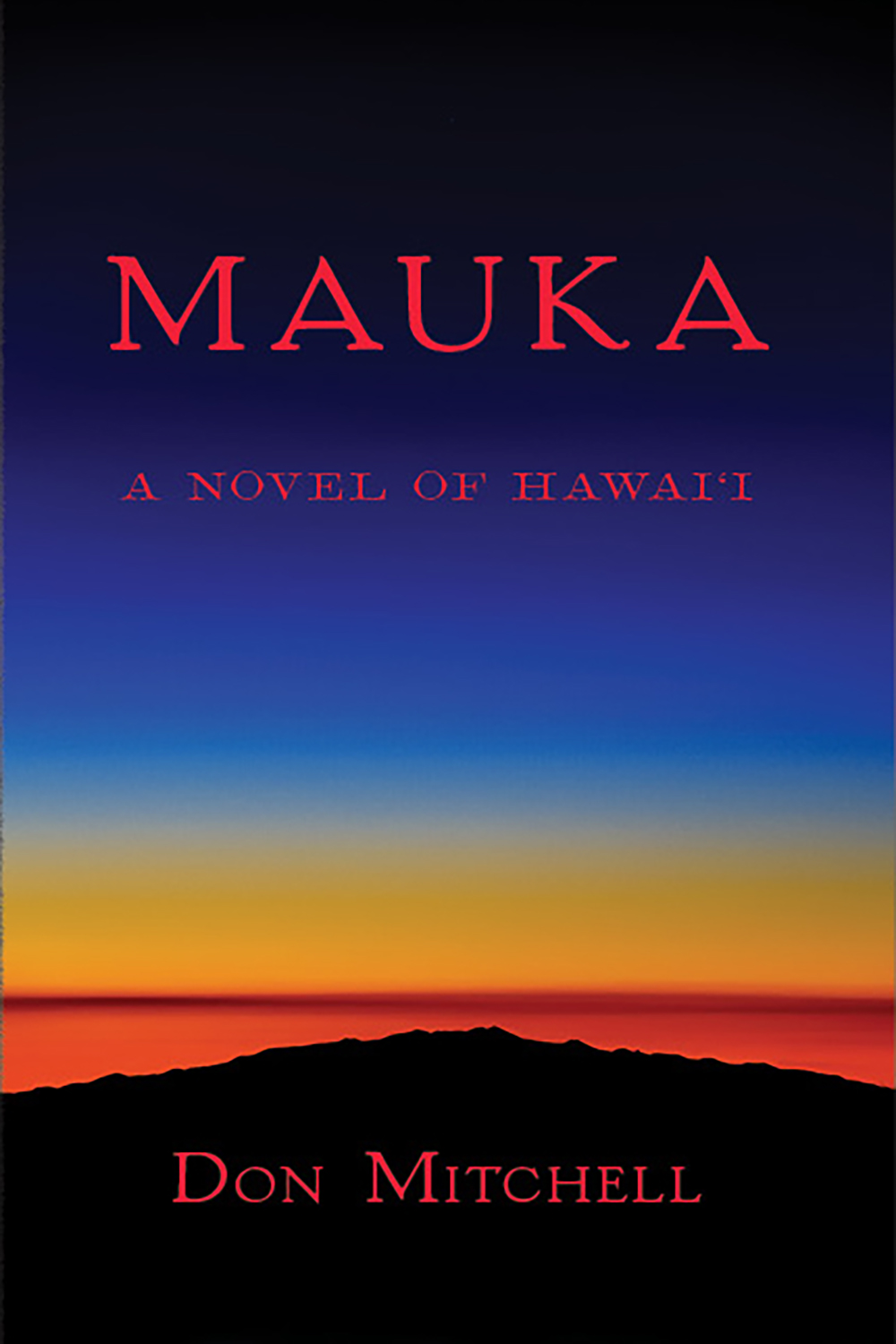
I hope people buy it and read it and although I hope readers will check out the Acks, I suspect that not many will.
So here they are — my cloud of helpers. I’ve edited out a couple of spoilers; Mauka isn’t a mystery but I don’t want to give away the ending:
Acknowledgments
I could never have completed Mauka without the loving help of Ruth Thompson, my partner (now wife) of twenty-two years. We lost track of each other in 1964, reunited forty years later at a college reunion, and have lived happily together in Colden, NY, Hilo, and now in Freeville, near Ithaca, NY. Over the years, Ruth read and marked up countless Mauka drafts; there’s nothing quite like having an accomplished poet edit one’s prose.
I thank the fine writers and good friends who read some or all of the manuscript in its various permutations and gave me valuable comments and suggestions: Ruth Thompson, Diane Gilliam, Phil Terman, John Mauk, Becky Cooper, Ginia Loo, “C.B.,” Donald Mengay, Tania Pryputniewicz, Jendi Reiter, Annie Mydla, Jim McVey, Stefan Kiesbye, Alison Davis, Esther Cohen, Betty Williamson, Jane McCafferty, Susan Schultz, Marcia Meier, Katherine Durrant, Kanoa Withington, and the late Edite Kroll. Juliet Kono Lee, Ronlyn Domingue, and Sean Beaudoin read a substantially-different earlier version. I thank Irving Feldman for our many conversations about the project.
I’m especially grateful for readings by two anonymous victims of youthful sexual assault, who gave special attention to June’s reactions and her later reflections. Four therapists helped me understand how June might have processed what was done to her, and her actions decades later: Judy Slater, Lisa Brothwell, Lake McClenney, and Katherine Durrant. Zen therapist Dane Cervine helped me with some of Max’s reactions and led me to the “hot iron ball” Zen metaphor.
Special thanks to those of my Hilo High classmates who taught me what a Japanese teenage girl’s life in 1950s Hilo was like (beyond what I knew as a fellow student), but who prefer to remain anonymous. I’m greatly indebted to them for sharing their memories, many of which were both funny and touching and dealt with subjects we could never have discussed as teenagers. One in particular always responded to what must have seemed an endless list of questions, volunteered extremely helpful information, and read the entire manuscript.
The men who taught me about Mauna Kea are all gone: my father Glenn Mitchell, “Yama,” Eugene Chinen, Frank Pavao, Ah Fat Lee, and the other Fish and Game guys stationed at Pohakuloa when I worked there in 1960. Ruth Thompson and the late Tim Lippold joined me for dozens of Mauna Kea trips on R-1, R-10, Keanakolu Road, Mana Road, and many other tracks. Jack Jeffrey introduced me to Hakalau National Wildlife Refuge and its rare birds and plants, including the Cyanea shipmanii which so affected Max. Jesse Eiben, entomologist, answered my white butterfly question. The unnamed reforestation group that welcomed Max and June is modeled after the Mauna Kea Forest Restoration Project.
For Mauna Loa information I thank Bobby Camara, Jillian Marohnic, Rick Hazlett, Dennis Knuckles, Jackson Bauer, and Ka Lei Nuuhiwa. Bobby Camara suggested shelly pahoehoe as a lethal danger, and my Hilo neighbor Dr. Chris King, MD, vetted the shelly injury sequence that led to a death. Talmage Magno (Hawai‘i County Civil Defense), Al Yano, and Kanoa Withington helped me understand how the recovery of a body on Mauna Loa would have been handled.
I built some of June’s mainland experiences on anecdotes from Hilo friends. The late Claudette Bellah Hagar told me about having been put into the International Dorm when she arrived at her mainland university. Sumiko Toyama told me about her confusion when, in Virginia in the early 1960s, she was confronted by “White” and “Colored” bathrooms.
I also want to acknowledge my Ithaca “Gateless” writing group: Katie Durrant, Erica Hostetler, Wendy Hammond, Angela Douglas, Kate Alt, Ruth Collins, Helene Finn, Chris Burnett, and Lauren Steele. Our Saturday afternoon sessions kept me sharp.
